For a couple who has already agreed to end their marriage, the thought of appearing before a Family Court can still be unsettling. Many people are unsure about what the judge will ask, whether both spouses have to speak, whether they will be questioned separately, and what actually happens during the hearing.
A mutual consent divorce is based on the agreement of both spouses, but it is still a court proceeding. The judge has to be satisfied that both parties understand the decision, have given their consent voluntarily, and have settled the important issues between them.
This article explains what couples can generally expect during the court hearings involved in a mutual consent divorce in India.
Important: Court procedure can vary depending on the Family Court, the facts of the case and the circumstances of the spouses. The following explains the general process rather than guaranteeing exactly what will happen in every court.
What Happens Before the Court Hearing?
Before the hearing, the divorce petition and supporting documents are prepared and filed before the appropriate Family Court.The petition generally contains information about the marriage, the period of separation, the decision to seek divorce by mutual consent and the terms agreed between the spouses.
What is the First Motion?
The First Motion is essentially the stage at which the spouses formally present their mutual-consent divorce petition and record their statements before the court.If you want to understand this stage separately, you can read our detailed explanation of the Mutual Divorce First Motion.
What Happens During the First Motion Hearing?
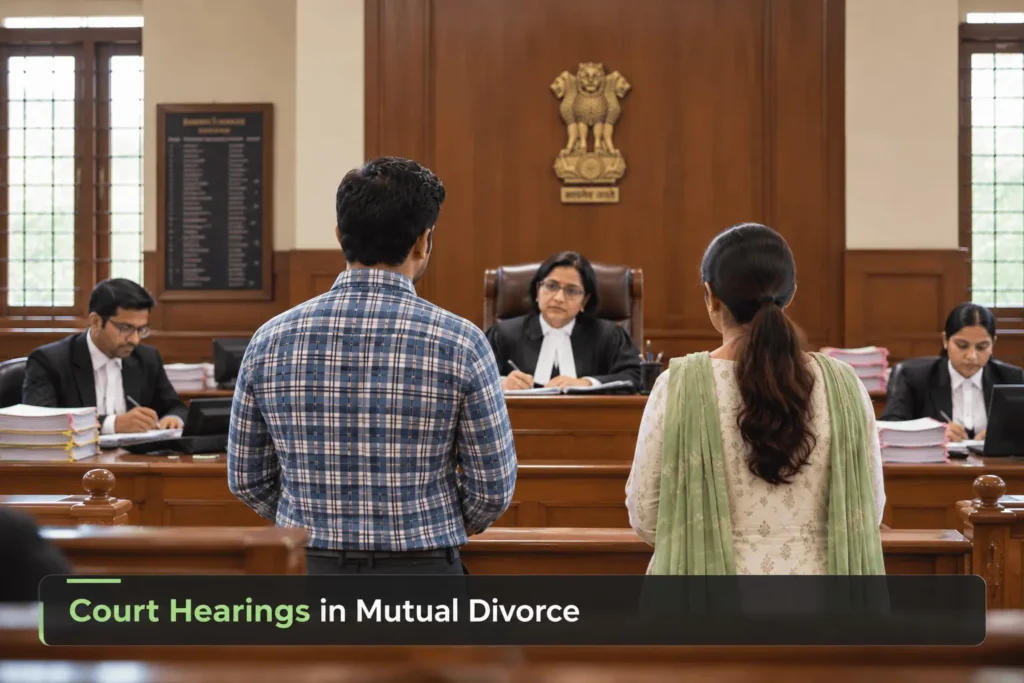
The First Motion is an important stage in a mutual consent divorce. Both spouses generally need to appear before the court, subject to the procedure permitted by the particular court and circumstances of the case. During the hearing, the judge may verify the identities of the parties and ask questions to establish that:
- The marriage took place.
- The spouses have been living separately for the required period, where applicable.
- They have mutually decided to seek divorce.
- Their consent is voluntary.
- There is no coercion, fraud or undue influence affecting their decision.
- They understand the terms of their settlement.
The questions are not necessarily complicated. In many cases, they are intended to establish that the decision is genuine and that both spouses understand what they are agreeing to.
For example, the court may ask a spouse whether they have voluntarily agreed to the divorce and whether they understand the settlement terms.
The exact questions and manner of recording the statements can differ from one court to another.
Will the Judge Question Husband and Wife Separately?
This can happen.
The court may record the statements of the spouses separately so that it can determine whether each person is independently giving consent to the divorce. This does not necessarily mean that something is wrong with the case. It is part of the court’s responsibility to ensure that consent is genuine.
A spouse should therefore answer the questions honestly and clearly rather than trying to memorise particular answers.
What About the Settlement?
The court may also consider whether the important issues between the spouses have been resolved.
For example, if the couple has children, the court may need to understand the arrangement concerning custody, visitation and financial responsibilities.
Similarly, where maintenance or permanent alimony has been agreed, the relevant terms may form part of the settlement between the parties.
This is one reason why couples should discuss these matters before the petition is filed. A mutual divorce is not simply an agreement to end the marriage; the practical issues arising from the separation should also be addressed.
What Happens After the First Motion?
The First Motion does not itself result in the final divorce decree. After the First Motion, there is ordinarily an interval before the Second Motion. Section 13B(2) of the Hindu Marriage Act provides for a period between the two motions, although the Supreme Court has recognised that the period may be waived in appropriate cases.
Whether a waiver is appropriate depends on the circumstances and the court’s consideration of the case. It should not be treated as an automatic part of every mutual divorce.
This period is sometimes referred to as the cooling-off period.
What Happens During the Second Motion Hearing?
The Second Motion is the stage at which the spouses again approach the court and confirm that they continue to consent to the divorce.
The court may again verify the identity and consent of both parties and consider whether the settlement remains intact. The judge may ask whether:
- Both spouses still want the divorce
- The consent remains voluntary
- The agreed settlement has been complied with, where applicable
- There has been any change in circumstances
- Issues relating to children or financial settlement have been addressed
Again, the exact procedure can vary between family courts of India. You can read more about this stage in our detailed article on the Mutual Divorce Second Motion.
Does the Judge Ask Why the Couple Wants a Divorce?
The court may ask questions about the marriage and the reasons for seeking divorce, but a mutual consent proceeding is different from a contested divorce. The purpose is generally not to conduct a lengthy trial about which spouse was responsible for the breakdown of the marriage.
The important question is whether the statutory requirements are satisfied and whether both spouses genuinely consent to the divorce. Couples should nevertheless be prepared to answer basic questions about their marriage and separation truthfully.
What If There Are Children?
Where children are involved, the court may pay particular attention to their welfare and to the arrangements agreed by the parents.The settlement may address:
- Who will have custody
- Visitation or parenting time
- Education expenses
- Medical expenses
- Other financial responsibilities
- Future arrangements for the child
The existence of children does not prevent a couple from seeking mutual consent divorce, but the arrangements concerning them should be properly considered before the petition is filed.
Does Everyone Have to Speak for a Long Time?
No, usually, the purpose of the statement is to establish the necessary facts and consent. It is not normally a long speech or presentation.
A spouse may simply have to answer questions put by the judge or court. However, couples should not assume that every hearing will take exactly the same amount of time. Court workload, the number of matters listed that day, documentation and case-specific issues can all affect the proceedings.
Do Both Spouses Always Have to Be Physically Present?
Physical appearance requirements can depend on the court and the circumstances of the case. In some situations, courts may permit appearances through video conferencing or make other procedural arrangements, but this should not be assumed automatically.
This becomes particularly relevant when one spouse lives in another city or outside India.
For NRI Mutual Divorce case, additional issues can arise involving documents, powers of attorney, attestation and arrangements for court appearances. The appropriate procedure depends on the facts and the court dealing with the case.
What Should You Do on the Day of the Hearing?
A few simple things can make the experience less stressful.
Carry the required documents – Your lawyer should tell you what original documents and copies are required for the particular hearing.
Reach the court with sufficient time – Family Courts can be busy, and you may need time to locate the courtroom or complete any procedural formalities.
Understand your settlement – Do not attend the hearing without being clear about what you and your spouse have agreed to regarding maintenance, property, children and other important matters. If you have prepared a mutual divorce agreement, make sure you understand all the terms.
Answer honestly – There is no need to memorise complicated legal language. Listen carefully to the question and answer it truthfully.
Stay in communication with your lawyer – If there is any last-minute change in circumstances, inform your lawyer before the matter is called.
What Happens After the Second Motion?
If the court is satisfied that the requirements for mutual consent divorce have been fulfilled, it may pass the divorce decree.
The decree is the formal court document recording the dissolution of the marriage. The exact sequence and timing of the order and certified copy can depend on the court and the circumstances of the case.
It is important to keep the decree safely because it may be required later for purposes such as remarriage, updating records, immigration matters, insurance, financial documentation or other legal requirements.
What If You Are Not Sure What Will Happen in Your Court?
This is where getting case-specific legal guidance can be useful. The procedure can differ depending on the Family Court, the location of the spouses, whether children are involved, whether there are pending cases and whether one spouse lives outside India.
If you need help understanding the mutual consent divorce process, FAM Legal can provide legal assistance and guidance based on your circumstances.
For a free consultation or legal support, you can call or WhatsApp +91-9310047950.
You can also submit your basic case details through the Mutual Divorce Application Form to get started.
Final Thought – A Family Court hearing may sound intimidating when you have never experienced one before. In a mutual consent divorce, however, the central purpose of the proceedings is to establish that both spouses are making the decision voluntarily and that the legal requirements for dissolving the marriage have been satisfied.
Knowing what to expect beforehand can make the process much less uncertain.
The most important preparation is not memorizing what the judge might ask. It is making sure that both spouses understand the decision, agree on the important issues and have the necessary documents and legal arrangements in place before appearing in court.