For couples living in Delhi, one of the first questions that comes up when considering a mutual consent divorce is simple but important: Which Family Court should we file the divorce petition in?
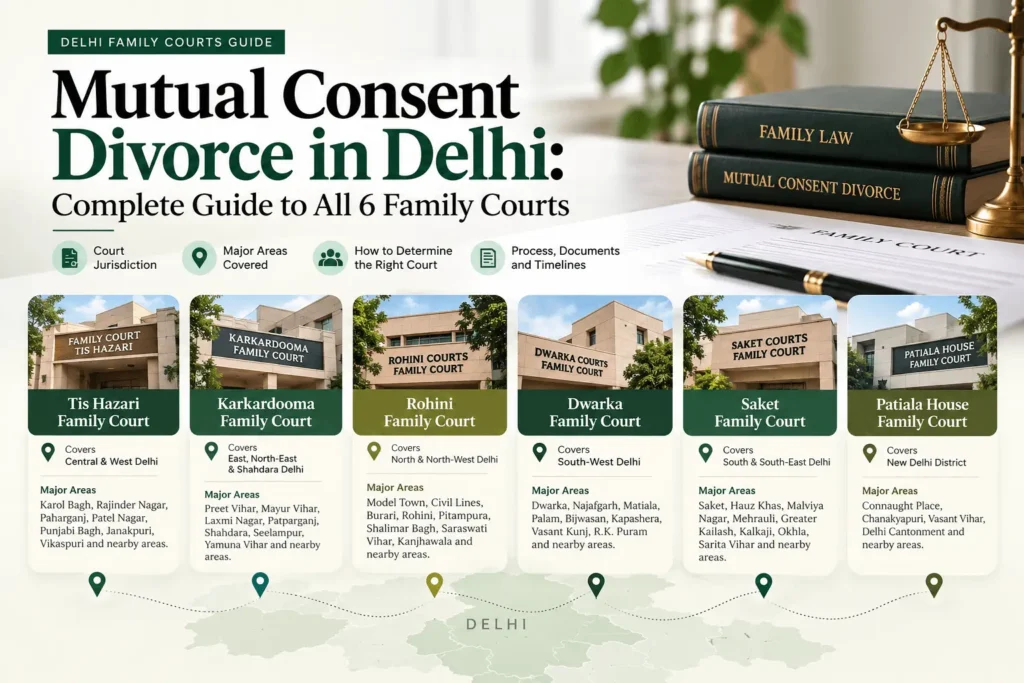
Delhi has six main District Court complexes where Family Courts function – Tis Hazari, Karkardooma, Rohini, Dwarka, Saket and Patiala House. The appropriate court is not selected simply because it is the closest court to your home. Jurisdiction depends on the facts of the marriage and the residence of the spouses, as provided under the applicable matrimonial law.
This guide explains how mutual consent divorce works in Delhi, how Family Court jurisdiction is determined, and which of the six court complexes generally handles matrimonial matters for different parts of Delhi.
What is Mutual Consent Divorce?
Mutual consent divorce is a divorce where both spouses agree that the marriage should be dissolved and jointly approach the court for a decree of divorce.
Under Section 13B of the Hindu Marriage Act, 1955, a petition for divorce by mutual consent can be presented when the statutory requirements are satisfied, including that the parties have been living separately for the required period and have mutually agreed that the marriage should be dissolved.
The process is different from a contested divorce because the spouses are not asking the court to decide allegations or determine which spouse is at fault. Instead, the court examines the petition, the statements and the legal requirements before passing the appropriate orders.
How Many Family Courts Are There in Delhi?
Delhi’s District Courts are organized across six main court complexes:
| Family Court Complex | Districts Generally Covered |
| Tis Hazari Courts | Central District and West District |
| Karkardooma Courts | East, North-East and Shahdara Districts |
| Rohini Courts | North and North-West Districts |
| Dwarka Courts | South-West District |
| Saket Courts | South and South-East Districts |
| Patiala House Courts | New Delhi District |
It is important to understand that a court complex is not itself the legal test for jurisdiction. The district and the facts establishing matrimonial jurisdiction determine where a petition can be presented.
1. Tis Hazari Family Court
Tis Hazari Courts is one of Delhi’s principal court complexes and is associated with the Central and West Districts. The Delhi District Courts’ current district information identifies Central District with Tis Hazari, while West District is also served through the Tis Hazari court complex.
For someone trying to understand this geographically, major areas associated with these districts include Karol Bagh, Rajinder Nagar, Paharganj, Patel Nagar, Punjabi Bagh, Rajouri Garden, Janakpuri, Vikaspuri and surrounding areas.
The exact court jurisdiction, however, is not determined simply by the locality in which a person currently lives. The matrimonial case must satisfy one of the applicable legal grounds for territorial jurisdiction. Tis Hazari may be relevant for couples connected with areas such as:
- Central Delhi
- West Delhi
Important: These are examples of major areas within the relevant districts and are provided only as a practical geographical guide. The correct Family Court must be determined from the facts of the marriage and the applicable law.
2. Karkardooma Family Court
Karkardooma Courts serves three Delhi districts for court purposes: East, North-East and Shahdara. The Delhi District Courts specifically identify North-East District and Shahdara District with Karkardooma Courts.
Karkardooma may be relevant for couples connected with areas such as:
- East Delhi: Preet Vihar, Mayur Vihar, Patparganj, Laxmi Nagar and surrounding areas
- Shahdara: Shahdara, Vivek Vihar, Seemapuri and surrounding areas
- North-East Delhi: Seelampur, Yamuna Vihar, Karawal Nagar and surrounding areas
For example, if both spouses last lived together in an area falling within East Delhi and the other statutory requirements for filing in Delhi are satisfied, the appropriate Family Court at Karkardooma may have jurisdiction.
The important point is that the district connection and the legal basis for jurisdiction need to be established, rather than selecting Karkardooma simply because it is the nearest court.
3. Rohini Family Court
Rohini Courts serves the North and North-West Districts. The Delhi District Courts identify both North District and North-West District with Rohini Courts. For residents trying to identify the relevant area, some major localities associated with these districts include Model Town, Civil Lines, Burari, Mukherjee Nagar, Rohini, Pitampura, Shalimar Bagh, Saraswati Vihar, Kanjhawala and surrounding areas.
Rohini may be relevant for couples connected with areas such as:
- North Delhi:
- North-West Delhi:
The exact jurisdiction should still be determined from the facts of the matrimonial case and the applicable statutory provisions.
4. Dwarka Family Court:
Dwarka Courts is associated with the South-West District. The Delhi District Courts identify Dwarka Courts with the South-West District and the court complex also deals with matters relating to the IGI Airport area. Dwarka Family Court may be relevant for couples connected with areas such as:
- Dwarka: Dwarka and surrounding residential sectors
- Najafgarh / Matiala: Najafgarh, Uttam Nagar-side areas and surrounding localities
- Bijwasan / Kapashera: Bijwasan, Kapashera and nearby areas
- Other South-West areas: Palam, Vasant Kunj, R.K. Puram and surrounding areas
For example, if a husband and wife last resided together in an area falling within South-West Delhi, that fact may provide a basis for jurisdiction under the applicable matrimonial law. Again, the relevant legal jurisdiction should be established from the facts of the case rather than simply from the couple’s nearest court complex.
5. Saket Family Court:
Saket Courts serves the South and South-East Districts. The Delhi District Courts identify South District with Saket Courts, while the South-East District is also associated with the Saket court complex. This covers a large part of southern Delhi. Major areas include Saket, Hauz Khas, Malviya Nagar, Mehrauli, Greater Kailash, Defence Colony, Kalkaji, Okhla, Sarita Vihar and surrounding areas. Saket may be relevant for couples connected with areas such as:
- South Delhi
- South-East Delhi
For couples living in these parts of Delhi, Saket is therefore an important Family Court complex for matrimonial proceedings. However, being a resident of South Delhi does not by itself answer every jurisdiction question. The applicable statutory grounds should still be considered before filing.al jurisdiction requirements.
6. Patiala House Family Court
Patiala House Courts is associated with the New Delhi District. The Delhi District Courts’ current district information identifies New Delhi District with Patiala House Courts.
The New Delhi District includes several prominent central and south-central areas, including – Chanakyapuri, Connaught Place, Vasant Vihar, Delhi Cantonment and surrounding areas.
How Is Family Court Jurisdiction Decided in a Mutual Divorce Case?
This is one of the most important parts of the process. A common misconception is that a couple can simply choose whichever Family Court they prefer. That is generally not how territorial jurisdiction works.
For example, under Section 19 of the Hindu Marriage Act, 1955, a matrimonial petition may be presented to the District Court within whose jurisdiction, among other statutory grounds:
- the marriage was solemnized;
- the respondent was residing when the petition was presented;
- the parties last resided together; or
- where the wife is the petitioner, she was residing on the date of presentation.
There are additional provisions for certain situations, including where the respondent is residing outside the territory to which the Act extends or has not been heard of for the statutory period.
Therefore, determining the correct Family Court requires looking at the actual facts of the marriage, not just the current address of one spouse.
A simple example
Suppose:
- the husband currently lives in Rohini;
- the wife currently lives in South Delhi;
- the couple last lived together in West Delhi.
The answer cannot automatically be “Rohini because the husband lives there” or “Saket because the wife lives there.” The relevant statutory grounds need to be examined to determine which court has jurisdiction. This is why the addresses and history of the marriage are important when preparing a mutual consent divorce petition.
Does the Place of Marriage Matter?
Yes, it can. Under Section 19 of the Hindu Marriage Act, the place where the marriage was solemnized is one of the statutory grounds of territorial jurisdiction.
For example, a couple may currently live in different parts of Delhi but may have solemnized their marriage in Delhi. Depending on the other facts and the law applicable to their marriage, the place of marriage may provide a basis for jurisdiction.
However, the place of marriage is not the only possible basis for jurisdiction. Residence and the place where the spouses last resided together can also be relevant.
What If One Spouse Lives Outside Delhi?
A spouse living outside Delhi does not automatically mean that a mutual divorce cannot be filed in Delhi Family Court. The question is whether a valid jurisdictional connection with Delhi exists under the law applicable to the marriage. For example, the marriage may have been solemnized in Delhi, or the parties may have last resided together in Delhi, subject to the applicable statutory provisions.
Where one or both spouses are now living outside India, the situation can involve additional procedural considerations. For NRI couples, we have a separate guide explaining the NRI mutual divorce process and the practical issues involved.
You can read our NRI Divorce guide for more information.
Is the Nearest Family Court Always the Correct Court?
No.
This is one of the most important things to understand. The Family Court closest to your present home may not necessarily have jurisdiction over your matrimonial case.
For instance, a couple may currently live near Saket but have a jurisdictional connection that places the petition before another Family Court. The correct approach is to first determine the legal basis of jurisdiction and then identify the corresponding district and Family Court.
What Happens After the Correct Family Court Is Identified?
Once the appropriate jurisdiction has been established, the mutual consent divorce process generally involves preparation and filing of the joint petition, appearance before the court, recording of statements and subsequent proceedings as required by law.
The overall process can be understood in stages:
- Eligibility and jurisdiction are examined
- Documents and information are collected
- The joint petition is prepared
- The petition is filed before the appropriate Family Court
- The spouses appear before the court for the First Motion
- The statutory requirements and consent are considered by the court
- The matter proceeds towards the Second Motion, where applicable
- The court passes the divorce decree after the legal requirements are satisfied
The exact procedure and timing can vary depending on the facts of the case, the court’s schedule and whether any statutory waiting period is applicable or waived in the circumstances permitted by law.
For a step-by-step explanation, see our Mutual Divorce Process guide.
How Long Does Mutual Divorce Take in Delhi?
There is no single guaranteed timeline for every mutual consent divorce case. The time involved can depend on factors such as:
- the court’s schedule;
- completeness of documentation;
- whether both spouses remain willing to proceed;
- the date available for the First Motion;
- the applicable statutory requirements; and
- whether the court permits waiver of the statutory waiting period in an appropriate case.
Where the waiting period is waived, some mutual consent divorce matters may be completed considerably sooner. Where it applies, the overall process can take longer. For this reason, it is better to treat any quoted timeline as an estimate rather than a guaranteed completion date.
What Documents Are Usually Required?
The exact documents depend on the circumstances of the spouses and the marriage, but a mutual consent divorce petition commonly requires documents and information relating to:
- identity and address of both spouses;
- marriage;
- photographs;
- details of the children, if any;
- details concerning the period of separation;
- residential addresses;
- financial or settlement arrangements where applicable; and
- other information required for preparing the petition and supporting documents.
It is important that the information provided to the court is complete and accurate.
Can Mutual Divorce Be Started Online in Delhi?
Some preliminary parts of the process can be handled remotely, such as sharing information, documents and completing an initial application.
However, mutual consent divorce itself is a court proceeding. Filing and document preparation may be facilitated electronically or remotely in appropriate circumstances, but the legal process should not be represented as a completely online divorce where no court involvement is required. The court remains central to the process because the spouses ultimately seek a judicial decree dissolving the marriage.
To start the process of Mutual Consent Divorce , the first step is to submit the Online Divorce Application Form.
What If the Couple Has Already Settled Their Financial and Other Issues?
Mutual consent divorce often involves the spouses reaching an understanding about matters such as:
- maintenance or permanent alimony;
- return or settlement of belongings;
- child custody and visitation;
- child-related expenses;
- jointly owned assets or liabilities; and
- withdrawal or settlement of pending cases, where legally and practically appropriate.
The exact terms depend entirely on the individual circumstances of the couple. It is important that any settlement is properly understood by both spouses and appropriately reflected in the legal documents where required.
What About the Cost of Mutual Divorce in Delhi?
The total cost of a mutual consent divorce can vary depending on the circumstances of the case, professional fees, documentation requirements and other expenses. Before proceeding, couples should understand what is included in the professional fee and what may be payable separately.
For information about our total fee structure for mutual divorce services, you can refer to our Mutual Divorce Fees page.
Frequently Asked Questions
Which Family Court handles mutual divorce in Delhi?
Delhi has Family Courts across six principal court complexes: Tis Hazari, Karkardooma, Rohini, Dwarka, Saket and Patiala House. The appropriate court depends on the territorial jurisdiction of the particular matrimonial case.
Can we choose any Family Court in Delhi for mutual divorce?
Generally, no. A mutual consent divorce petition must be presented before a court having jurisdiction under the applicable matrimonial law. The spouses cannot simply select a court because it is more convenient.
Does the wife’s residence matter for jurisdiction?
In cases governed by the Hindu Marriage Act, Section 19 specifically provides an additional jurisdictional ground where the wife is the petitioner and is residing on the date of presentation of the petition, subject to the statutory requirements.
Can we file for mutual divorce if we live in different districts?
Potentially, yes. Living in different districts does not by itself prevent mutual divorce. The appropriate jurisdiction must be determined from the statutory grounds applicable to the case.
Does the marriage have to be registered in Delhi?
Not necessarily. The question of jurisdiction is governed by the applicable matrimonial law and the facts of the case. The place where the marriage was solemnized can be one of the jurisdictional grounds under the Hindu Marriage Act.
Can NRI couples get a mutual divorce through Delhi Family Court?
In appropriate cases, an NRI couple may have a valid jurisdictional connection with Delhi, but the circumstances need to be examined carefully. NRI cases can also involve additional documentation and procedural considerations.
For more information, see our NRI Divorce guide.
Final Word
For a couple considering mutual consent divorce in Delhi, identifying the correct Family Court is one of the first practical steps. The six principal court complexes — Tis Hazari, Karkardooma, Rohini, Dwarka, Saket and Patiala House — cover different districts of Delhi. But the correct court is determined by the applicable rules of territorial jurisdiction and the facts of the marriage, rather than simply by which court is closest to the couple’s current residence.
If you are unsure which Family Court has jurisdiction over your marriage, it is sensible to establish that point before preparing and filing the petition. Getting the jurisdiction right at the beginning can help avoid unnecessary procedural complications later.
For couples who want to begin the process by providing their basic case details, our Mutual Divorce Application Form is available online.