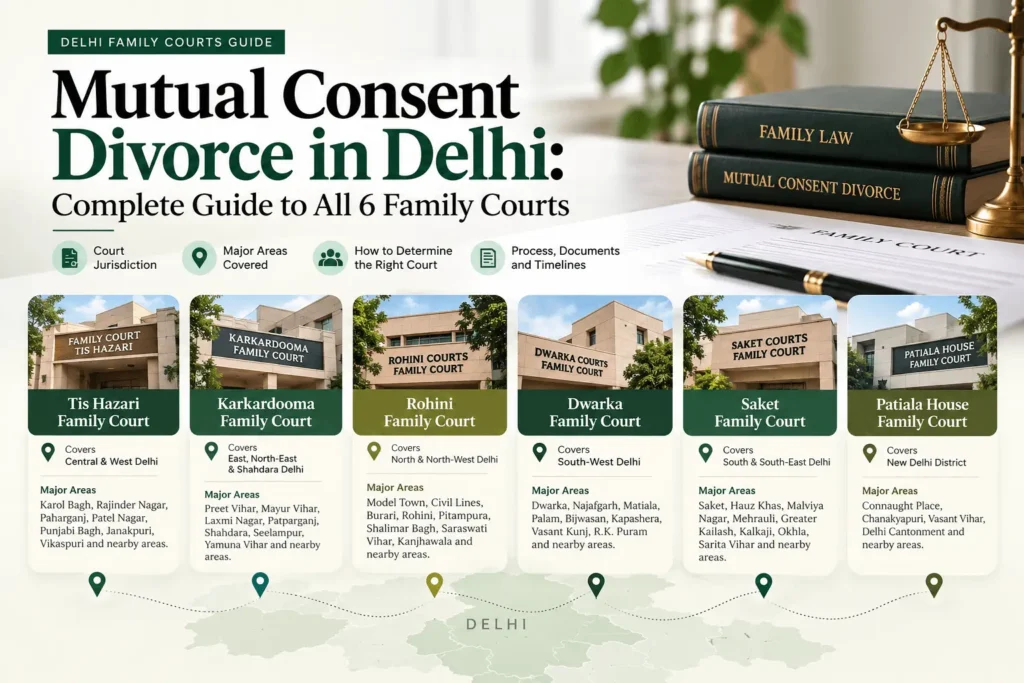
If you and your spouse have mutually decided to end your marriage, mutual consent divorce can be a more straightforward legal route than a contested divorce. But “mutual” does not mean that there are no legal or procedural issues to work through. For couples living in Noida, Greater Noida or elsewhere in Gautam Buddh Nagar, there are also some local practical points worth understanding before the petition is filed — particularly where the Family Court is located, jurisdiction, representation of both spouses, the First and Second Motion, and the cooling-off period.
Here are 10 things couples should know before starting a mutual consent divorce in Noida.
1. First, Make Sure Noida Is the Correct Jurisdiction
Before preparing a divorce petition, it is important to establish which court has territorial jurisdiction over the marriage.
Simply living in Noida does not automatically mean that every matrimonial case must be filed in Noida. Depending on the matrimonial law applicable to the marriage, factors such as:
- where the marriage was solemnized;
- where the respondent resides;
- where the couple last resided together; and
- in certain circumstances, where the wife resides
can be relevant to determining jurisdiction.
For example, consider a couple who were married in Delhi but subsequently moved to Noida and lived together there. Their situation may raise different jurisdictional considerations from a couple who married in another city, never lived together in Noida, and now happen to have one spouse residing there.
This is why jurisdiction should be checked before the petition is drafted and filed, rather than simply choosing the court that appears geographically closest.
2. Know Where the Noida Family Court Is Located
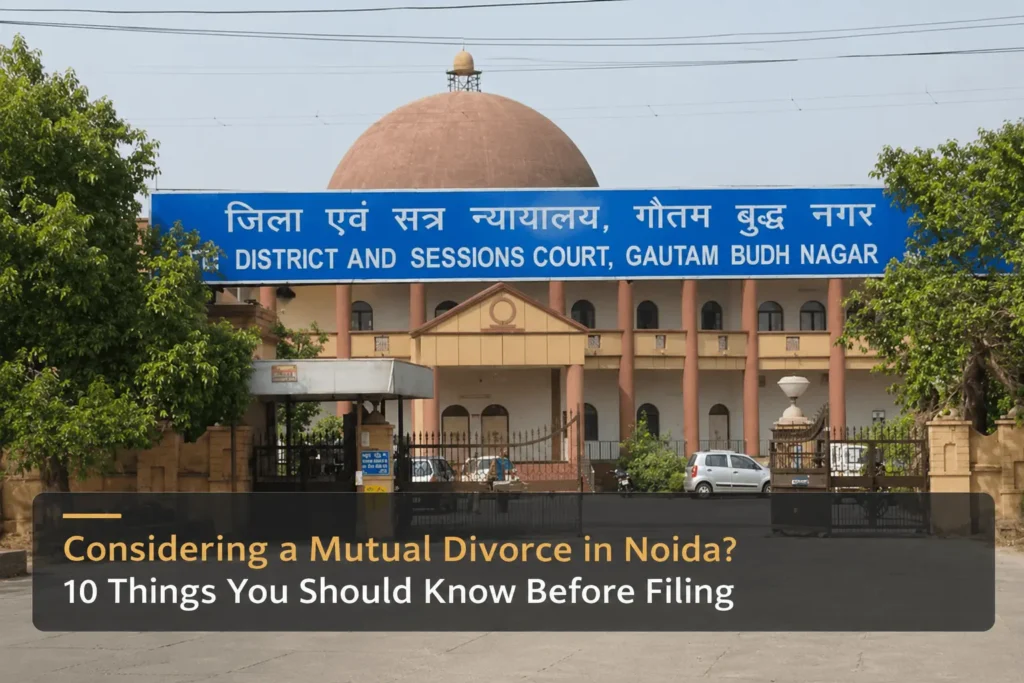
For couples whose matrimonial matter falls within Gautam Buddh Nagar, the relevant Family Court is at the District Court Complex, Surajpur, Greater Noida, Uttar Pradesh.
The Gautam Buddh Nagar district administration identifies its Collectorate at Surajpur, Greater Noida, and court records identify the Family Court, Gautam Buddha Nagar, District Court Complex,Surajpur.
Noida Family Court address:
Family Court, District Court Complex,
Surajpur, Greater Noida,
Gautam Buddh Nagar, Uttar Pradesh
Although people commonly search for it as the “Noida Family Court”, the formal district designation is Family Court, Gautam Buddh Nagar. This distinction can be useful when searching for court listings, case information or directions to the court complex.
3. Understand the Local Advocate Arrangement Before Filing
This is an important practical point for couples approaching the Gautam Buddh Nagar Family Court. In many mutual consent divorce matters, people assume that one lawyer can simply represent both husband and wife because both spouses are agreeing to the divorce.
However, couples filing at the Gautam Buddh Nagar Family Court should clarify the current local practice regarding representation of the two spouses. In practice, separate representation for the husband and wife may be required for the proceedings. This is different from assuming that one advocate will necessarily handle both sides.
Why does this matter?
If you are preparing to file a mutual consent divorce, it is better to understand the representation arrangement before the petition and supporting documents are finalised. The requirement should be treated as a court-specific procedural practice rather than a general rule that applies to every Family Court in India.
4. Mutual Consent Means More Than Simply Agreeing to Divorce
A couple may both agree that they want a divorce, but there can still be important matters to settle before filing. Depending on the circumstances, these may include:
- maintenance or permanent alimony;
- return of jewellery and personal belongings;
- division or settlement of financial interests;
- child custody;
- visitation arrangements;
- education and other expenses for children;
- jointly owned property or liabilities;
- pending litigation between the spouses; and
- any other claims arising from the marriage.
For example, a couple may agree completely on getting divorced but still disagree about who will retain certain belongings or how visitation with their child will work. That is why it is preferable to clarify the important settlement terms before the mutual consent petition is filed.
A mutual consent divorce works on the basis of continuing agreement between the spouses. If significant issues remain unresolved, the matter may require further discussion before the petition can properly proceed.
5. Keep Your Documents Ready Before Filing
Having the relevant documents and information ready can make the initial preparation considerably easier. Depending on the circumstances, documents and information may include:
- identity proof of both spouses;
- address proof;
- marriage certificate or other proof of marriage;
- photographs;
- details and documents relating to children, if applicable;
- present and previous addresses;
- details concerning the period of separation;
- information regarding employment or financial arrangements where relevant;
- details of any previous or pending court proceedings; and
- documents relating to any settlement reached between the spouses.
The exact documentation can vary from one case to another. It is also important that the information provided in the petition and supporting documents is complete and accurate. An incorrect address, incomplete information about previous litigation or an overlooked proceeding can create avoidable procedural complications.
If you would like assistance with understanding the process or preparing to start your case, you can reach out to us on +91-9310047950 by call or WhatsApp.
To start your mutual divorce case in Noida, you can submit our Mutual Divorce Application Form.
6. The First Motion Is Only the Beginning of the Divorce Process
One common misunderstanding is that the divorce is completed as soon as the mutual consent petition is filed or the First Motion is recorded.
That is not the case.
A typical mutual consent divorce under the Hindu Marriage Act involves two stages:
First Motion – Both spouses jointly present the petition and their consent is recorded before the court after the necessary examination of the case.
Second Motion – After the statutory requirements relating to the period between the two motions are satisfied, the spouses proceed with the Second Motion, subject to the requirements of the applicable law and the court.
If the court is satisfied that the statutory requirements have been met and the consent remains valid, it can pass the decree dissolving the marriage.
The exact procedure can vary depending on the circumstances of the case and the applicable matrimonial law.
You can read our guide to the mutual divorce process for a stage-by-stage explanation.
7. Understand the Six-Month Cooling-Off Period
The six-month cooling-off period is one of the most commonly misunderstood parts of mutual consent divorce.
Under Section 13B(2) of the Hindu Marriage Act, the second motion is ordinarily made not earlier than six months after presentation of the mutual consent petition and not later than eighteen months, if the petition has not been withdrawn.
However, the Supreme Court has held that the six-month period can be waived by the court in appropriate exceptional circumstances. In Amardeep Singh v. Harveen Kaur, the Supreme Court considered whether the six-month period was mandatory or could be relaxed in appropriate cases.
This does not mean that every couple automatically gets the waiting period waived. The circumstances of the individual case matter, and waiver is a matter for the court to consider. If you want to understand the cooling-off period and possible waiver in greater detail, you can read our dedicated guide on the cooling-off period in mutual divorce.
8. Be Prepared for Court Proceedings
A mutual consent divorce is not simply an online formality. Even where documents and preliminary information can be shared electronically, the divorce itself remains a judicial proceeding.
The spouses may be required to appear before the court and have their statements recorded at the relevant stages. The exact appearance requirements can depend on the circumstances of the case and the directions or procedure followed by the court.
Therefore, couples should not assume that submitting an online application means that the entire divorce will be completed online without any court proceedings.
This is particularly important for couples who are living in different cities or countries.
9. An NRI or Overseas Spouse Can Change the Practical Process
Noida has a large number of families with one spouse working or living outside India. A mutual divorce can therefore involve situations such as:
- husband living in Noida and wife living in the USA;
- wife living in Noida and husband working in Dubai;
- both spouses living outside India but retaining a jurisdictional connection with India; or
- one spouse moving abroad after the separation.
An overseas spouse can create additional procedural considerations involving documents, identification, attestation, Power of Attorney and appearance arrangements, depending on the circumstances.
The fact that one spouse lives abroad does not by itself answer the jurisdiction question. The particular facts of the marriage need to be examined. For a more detailed discussion of these situations, see our NRI Divorce guide.
If your case involves an overseas spouse and you are unsure how the process would work, you can also reach us directly on +91-9310047950 by call or WhatsApp.
10. Check Everything Before the Petition Is Filed
The easiest time to identify a problem with a mutual divorce case is before filing, not after. Before the petition is prepared, both spouses should ideally have clarity about:
Jurisdiction → Settlement → Documents → Representation → Filing → First Motion → Second Motion → Divorce Decree
A few minutes spent checking these matters at the beginning can help avoid unnecessary procedural issues later.
For example, if the couple discovers after preparing the petition that the chosen court does not have the necessary territorial jurisdiction, the filing process may need to be reconsidered.
Similarly, if the spouses have not actually settled an important issue concerning maintenance, children or property, the mutual consent process may not be as straightforward as they initially expected. The objective should therefore be to make sure that both spouses understand what they are agreeing to and that the petition accurately reflects their agreement.
Frequently Asked Questions About Mutual Divorce in Noida
Can we file for mutual divorce in Noida if we got married in Delhi?
Potentially, depending on the other jurisdictional facts. The place where the marriage was solemnized is one possible jurisdictional factor under the Hindu Marriage Act, but it is not the only one. The parties’ residence and place of last shared residence can also be relevant.
Do both husband and wife need separate lawyers in Noida?
Couples should confirm the current representation and filing practice of the Gautam Buddh Nagar Family Court. In practice, separate representation may be required for the two spouses, even though they are jointly seeking mutual consent divorce.
This should be clarified before filing rather than assumed from the practice followed by another Family Court.
Does the six-month waiting period always have to be completed?
Not necessarily. Section 13B(2) provides the ordinary six-month interval, but the Supreme Court has recognised circumstances in which the waiting period may be waived by the court. Such waiver is not automatic and depends on the circumstances of the case.
Do both spouses have to appear before the Family Court?
Mutual consent divorce involves judicial proceedings and the spouses may be required to appear at the relevant stages. The precise procedure can depend on the circumstances and the directions of the court.
Can an NRI spouse get a mutual divorce in Noida?
An NRI spouse does not automatically prevent a mutual divorce from being filed in Noida. However, jurisdiction, documentation, attestation, Power of Attorney and appearance requirements may need additional consideration.
How long does mutual divorce take in Noida?
There is no single guaranteed timeline. The duration can depend on the court schedule, documentation, the First Motion date, whether a waiver is sought or granted, the Second Motion and the continued consent of both spouses.
What if husband and wife live in different cities?
Living in different cities does not by itself prevent a mutual consent divorce. The appropriate jurisdiction has to be determined from the facts of the marriage and the applicable law.
Need Help With a Mutual Divorce in Noida?
Every mutual divorce case has its own combination of facts — particularly when the spouses live in different cities, have children, have financial settlements to record, or one spouse is living abroad.
If you need legal assistance regarding mutual consent divorce in Noida, Family Court jurisdiction, documentation or the filing process, you can reach us at: Call / WhatsApp: +91-9310047950
You can also begin by providing your basic details through our Online Divorce Application Form .