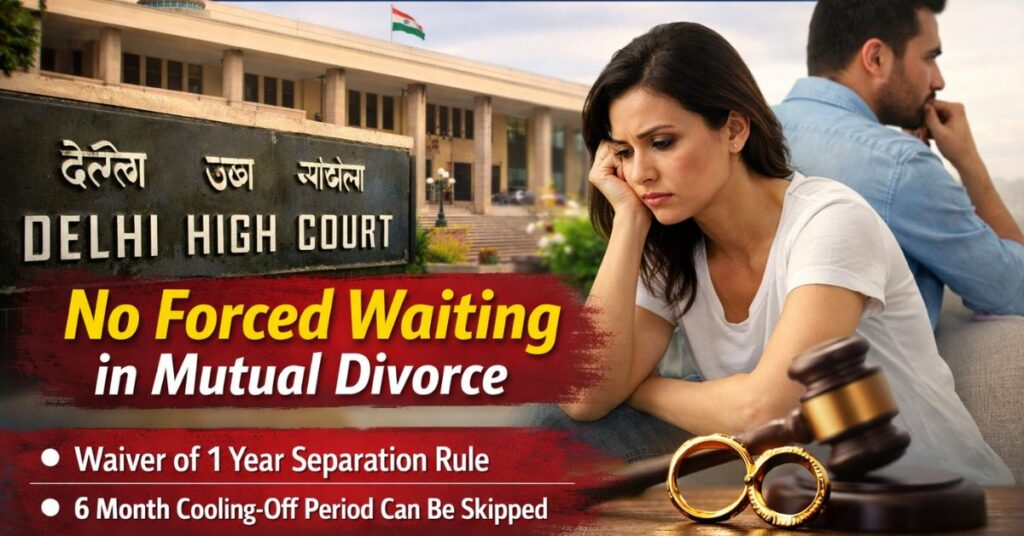
In an important judgment delivered on 17 December 2025, the Delhi High Court clearly said that courts should not unnecessarily delay mutual divorce cases when both husband and wife genuinely want to separate. The Court held that legal waiting periods should not be used to keep people trapped in unhappy marriages.
This judgment brings much-needed clarity and relief to couples who have already decided to end their marriage peacefully.
What Was the Issue?
Under Indian law, a couple seeking mutual consent divorce must usually:
Live separately for one year before filing the case
Wait another six months between the first and second court hearings
Many courts treated these time limits as compulsory, even when the marriage had clearly failed. As a result, couples were forced to wait months—or even years—despite mutual agreement.
The Delhi High Court was asked a simple but important question:
Can courts relax these time limits in genuine cases, or are they bound to enforce them strictly?
What Did the Court Decide?
The Full Bench of the Delhi High Court gave a clear and practical answer:
✅ Yes, courts can relax both waiting periods
The Court ruled that:
The one-year separation rule can be waived
The six-month cooling-off period can also be waived
Both waivers can be granted together, if circumstances justify it
This power is available not only to the Supreme Court, but also to Family Courts and High Courts.
When Can These Periods Be Waived?
The Court made it clear that waivers are not automatic. Judges must be satisfied that:
The marriage has completely broken down
Both parties are acting freely and willingly, without pressure
There is no real chance of reconciliation
Continuing the marriage would cause serious emotional or mental hardship
In such cases, forcing people to remain legally married serves no useful purpose.
Immediate Divorce Is Also Allowed
Earlier, some courts believed that even if waiting periods were waived, the divorce decree should only take effect later. The Delhi High Court rejected this idea.
It held that:
If the court is satisfied, it can grant immediate divorce
Couples do not have to remain legally married just to complete a technical time requirement
The law, the Court said, should help people move on—not keep them stuck.
Why Is This Judgment Important?
This ruling recognises modern realities:
Some marriages fail very early
Some couples never start married life properly
Prolonged legal ties can cause emotional stress and block future life plans
The Court strongly observed that marriage is based on free consent, and when that consent no longer exists, the law should respect personal choice and dignity.
In powerful words, the Court said courts should not push unwilling people into a “matrimonial abyss” in the name of saving marriage.
Safeguards Against Misuse
To prevent misuse, the Court also clarified:
Waivers should not be granted casually
Judges must carefully examine each case
If the court finds false statements or hidden facts, it can refuse or delay divorce
This ensures that the system remains fair and balanced.
What This Means for Couples
For couples seeking mutual divorce, this judgment means:
Faster resolution in genuine cases
Less emotional and financial stress
Greater respect for personal autonomy
More humane and practical family court processes
It is especially helpful in cases of short marriages, long separation, or complete emotional breakdown.
Conclusion
The Delhi High Court’s decision marks a major step forward in Indian family law. It confirms that law exists to serve people, not trap them in failed relationships. By allowing flexibility in mutual divorce timelines, the Court has made the legal process more compassionate, realistic, and aligned with constitutional values of dignity and freedom.